Common Kite Flying Mistakes in Gusty UK Weather (and How to Fix Them)
British wind rarely holds a number. A steady twelve miles per hour is a gift; more often you get eight, a shove to twenty, then a dead patch that leaves the lines slack on the grass. That variability makes flying here interesting, and it exposes habits that work fine on calm days but collapse the moment the wind starts breathing in gusts.
Most spoiled sessions are not the fault of the kite. They come from launching at the wrong angle, steering too much, and judging the wind from the car park instead of the sky. Here are the mistakes that turn up again and again, and the fixes that work.
Launching Downwind and Loading the Lines Too Early
This is the mistake that ends sessions before they start. You set the kite out with the wind at your back, walk to the handles and let it fill. A single-line delta launched from your hands like that is fine — that is how it is meant to work. A dual-line or power kite is not so forgiving. Sit it flat in the middle of the wind window and the first decent gust fills it instantly, drags it across the grass and buries a tip before you have tension in both lines.
The fix is to have the kite at the edge of the window before it takes any load.
- Stand so the wind crosses your shoulders rather than hitting your back square-on, and lay the kite out downwind of you, roughly side-on to the wind.
- Weight the upwind tip with a little sand or a soft bag, or ask someone to hold it, while you walk back.
- Stop when the lines are just taut, then take one pace upwind to load them gently.
- Let the kite fill and steer it straight up to the top edge of the window. You want to be flying before the next gust arrives, not arguing with the ground.
Oversteering: The Death Grip and the Double Correction
In choppy air the temptation is to hold tighter and correct faster. That is exactly the wrong instinct. A stunt kite responds to a few centimetres of line, and every wobble answered with a yank makes the next correction bigger. Half a minute later you are sawing at the handles, the kite is snaking across the window, and the lines are one bad moment from a tangle.
- Give one input at a time, and stop before you think you should. Most turns carry on by themselves once they have started.
- Watch the leading edge rather than the trailing edge. The leading edge shows where the kite is going; the trailing edge only shows where it has been.
- Let small wobbles happen. Kites recover from most of them unaided, and your correction is more likely to knock it out of the air than the gust was.
- Steer with your wrists, not your shoulders. If your arms are locked straight, you have no slack left to give.
A useful drill on a blustery day: slow figure eights at arm's height, then square corners. Both force small, definite inputs instead of constant fiddling. If the kite does luff, walk forward to slacken the lines and let it reset rather than dragging it back into the air.
Misjudging Gusts and Missing the Signs
Gusts here usually arrive in cycles rather than at random. Watch one full cycle before you launch and you will often spot the pattern: a minute of steady air, then a push, then a lull. Aim your launch at the lull.
- Long grass, ripples on a pond and the tops of trees show the wind before it reaches you. Dark patches running across water are a gust, and it is heading your way.
- A flag, a windsock or a line of smoke gives you direction and strength at a glance.
- Listen to the trees. A hiss is steady air; a roar means brace.
- Feel for a cooler patch on the back of your neck. Gusts often run colder than the air around them.
When a gust hits, fly low and towards the edge of the window, where the kite generates least pull, and walk towards it to give the lines slack. If you have a trim or depower system, use it. What you should not do is stand still and fight, holding the kite in the middle of the window with both arms braced. That is how lines snap and how flyers get lifted off their feet.
Know when to stop
If you cannot hold the kite steady at the edge of the window, or landing feels like a gamble, land and pack up. Ten minutes on the ground with a flask beats an afternoon replacing a leading edge. Thin lines can burn bare hands, so gloves are sensible in a cold, strong wind, and children should always be supervised when the wind is up.
Flying the Wrong Kite for the Day's Wind Range
A gusty afternoon can span a whole kite's comfort zone. The kite that flies beautifully in the lulls is often over-powered in the gusts, and that is where the drama starts. If you own just one kite, learn its adjustable bridle or brake settings at home in light wind, so you can calm it down when the day turns lively.
Two kites cover a gusty afternoon far better than one. Pick a second that overlaps only slightly with the first, so one handles the calm and the other copes with the gusts. Check your lines as well: match their strength to the kite and the conditions, feel along them for nicks and stiffness, and replace anything damaged. A worn line that fails becomes a loose kite and a long walk.
Spot Choice: Why a Sheltered Field Makes the Wind Worse
Trees, hedges, buildings and cliffs do not block wind so much as break it up. The rough patch stretches well downwind of the obstacle — often several times its height — and it will make a well-behaved kite flap and luff. The field that looks calm and protected is frequently the hardest place to fly on a gusty day.
Look for open ground with a clean run of wind. On the coast, wind off the sea is generally smoother than wind off the land, and beaches give you space and soft landings, though dunes and cliffs behind you can throw sudden rotors and downdraughts. Keep well clear of overhead power lines, railway lines, roads, busy paths, car parks and airports, and check local restrictions or byelaws for parks, beaches and nature reserves before you set up.
A Five-Minute Check Before Every Launch
- Look at the wind, not just the forecast. Check trees, grass and flags, and watch one full gust cycle.
- Match the kite and lines to the strongest wind you expect, not the weakest.
- Lay the lines out straight, untwisted and free of wear.
- Set up at the edge of the window, kite side-on to the wind, lines just taut.
- Launch in a lull, fly straight to the edge of the window, and only then start flying properly.
- Agree a landing plan and your boundaries if anyone is flying with you.
Gusty air is not the enemy. It is the reason flying in Britain feels like flying, and one blustery afternoon will teach you more than a week of steady breeze. Get the launch right, keep your inputs small, and read the sky as well as the kite. And when the wind is beyond you, put it away — the next decent day is rarely far off.
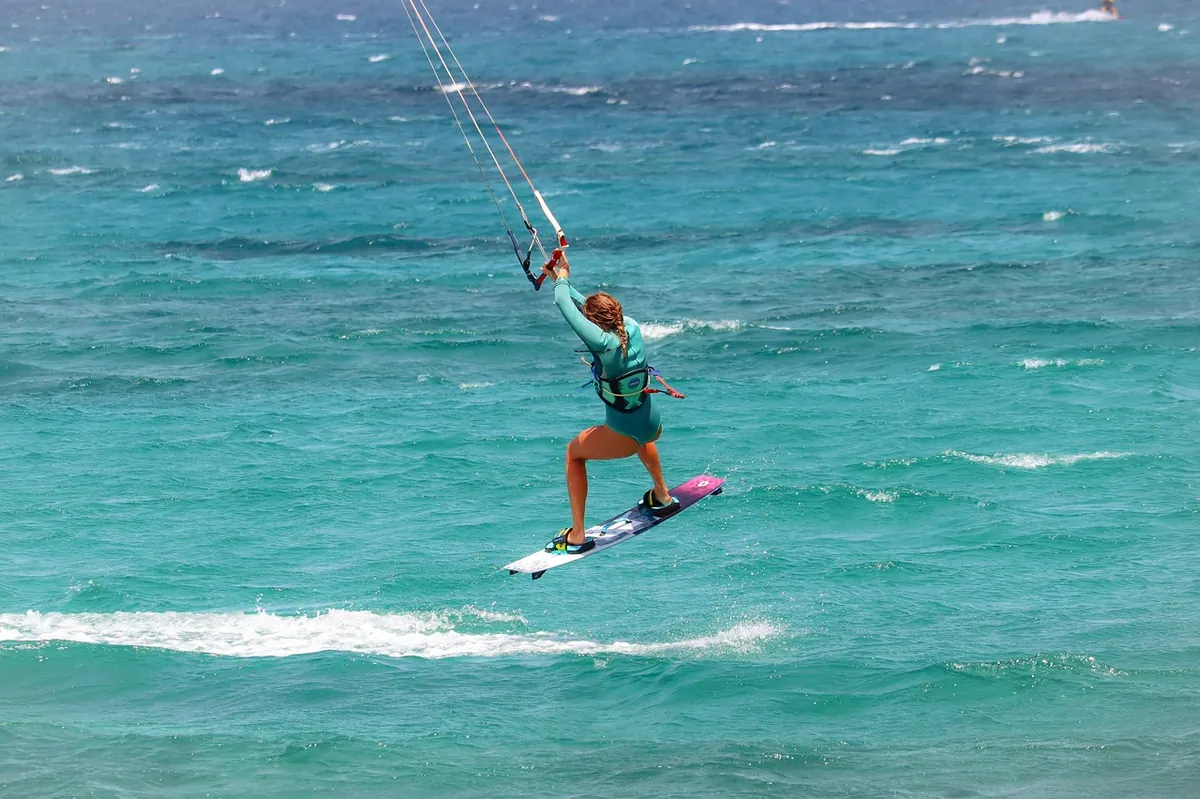
Photo: Tho-Ge / Pixabay